Non-Runner Each-Way Bets: What Happens to Your Wager When a Horse Is Withdrawn
Best Horse Racing Betting Sites – Bet on Horse Racing in 2026
 Available in US
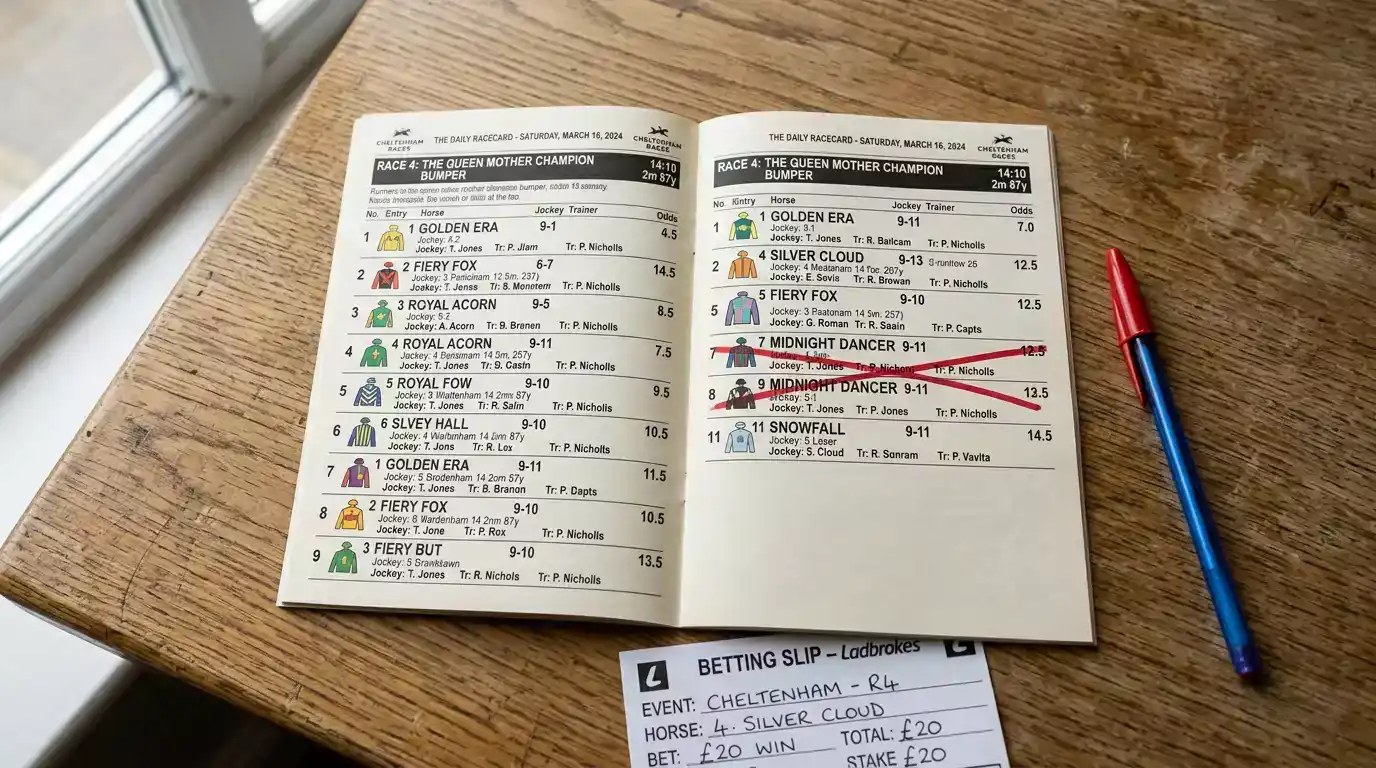
Table of Contents
- The Withdrawal That Reshapes Your Bet
- Your Horse Is the Non-Runner: Stake Returned or Bet Void
- Another Horse Is the Non-Runner: Rule 4 and Place Term Changes
- Ante-Post Non-Runners: No Refund, No Rule 4
- Non-Runners in Each-Way Multiples: How One Withdrawal Restructures the Bet
- Top online casinos in the UK
- Non-Runner Each-Way Questions Answered
The Withdrawal That Reshapes Your Bet
I had an each-way double running one Saturday at Cheltenham. Both horses were priced around 10/1, both looked like solid place contenders. Then, ninety minutes before the second race, my second selection was pulled out — ground too firm for the trainer’s liking. My double collapsed into a single. The first leg had already won. What should have been a four-figure payout became a straightforward win single at 10/1. That experience taught me to think about non-runners before they happen, not after.
Non-runners are a routine part of horse racing. Trainers withdraw horses for dozens of reasons — unsuitable going, minor injury, travel issues, overnight scoping that reveals a problem. The BHA reported that average turnover per race on core fixtures fell 14.4% year on year in Q1 2025, and late withdrawals are one of the factors that frustrate punters and erode confidence in early-price betting. When your selection is scratched, the settlement rules depend on when you placed the bet and what type of wager you hold.
Your Horse Is the Non-Runner: Stake Returned or Bet Void
If the horse you backed is withdrawn, the standard rule is simple: your bet is void and your stake is returned. Both the win and place parts of an each-way bet are cancelled. You receive a full refund of your total outlay.
This applies to day-of-race bets at fixed odds. The bookmaker voids the bet because the contract — backing a horse that is no longer running — cannot be fulfilled. There is no partial settlement, no deduction, and no ambiguity. Your ten pounds each-way (twenty pounds total) comes back in full.
The exception is ante-post bets, which I will cover separately. The key point for standard-market each-way bets is that a withdrawal of your selection is a non-event financially. You lose nothing except the opportunity cost — the time between placing the bet and receiving the refund, during which your money was unavailable for other bets.
Another Horse Is the Non-Runner: Rule 4 and Place Term Changes
When a horse other than your selection is withdrawn, your bet stands — but the landscape has changed. The remaining field is smaller, the competitive balance has shifted, and the odds that seemed fair when you placed the bet may now be too generous. This is where Rule 4 deductions enter the picture.
A Rule 4 deduction adjusts your payout downward based on the price of the withdrawn horse. The shorter the non-runner’s price, the larger the deduction. If a 2/1 joint-favourite is scratched, your payout on the remaining runners is reduced by 20p in the pound — applied to the profit element of both the win and place parts of your each-way bet.
But Rule 4 is only half the story. The other half — and the part that catches more punters off guard — is the potential change to place terms. If enough horses are withdrawn to reduce the field below certain thresholds, the number of places paid can shrink. A race that declared with sixteen runners and four places at 1/4 odds might lose three horses before the off, dropping to thirteen runners and three places. If your horse finishes fourth, you no longer have a placed horse. The extra coverage you thought you had evaporates with the non-runners.
Favourites in British racing win approximately 30-35% of the time, per Matchbook Insights data, and a withdrawal of the favourite can dramatically alter the probability landscape for every remaining runner. The Rule 4 deduction attempts to compensate, but it is a blunt tool — it does not perfectly recalibrate every bet in the market.
Ante-Post Non-Runners: No Refund, No Rule 4
Ante-post betting carries a different contract. When you place an ante-post each-way bet — days, weeks, or months before the race — the price reflects the risk that your horse might not run. If it is subsequently withdrawn, your stake is lost. No void, no refund, no Rule 4 adjustment on other runners. The risk of non-running is baked into the ante-post price, which is why ante-post odds are generally more generous than day-of-race prices.
The Grand National is the starkest example. Approximately 250 million pounds was wagered on the 2025 Grand National, per grandnational.fans estimates, and a substantial portion of that was staked ante-post in the weeks and months before the race. Horses regularly fail to make the final field — weights, injury, entries at other meetings, and the ballot for places all thin the field between the initial entry stage and the final declarations. Punters who backed a horse at 33/1 in January and saw it fail to make the cut in April lose their stake entirely.
The practical rule I follow for ante-post each-way bets: only commit to a horse you believe is highly likely to run. The each-way value at ante-post prices can be exceptional — but only if the horse actually lines up. A 20/1 ante-post each-way bet that ends in a non-runner refund of zero is worse than a 14/1 day-of-race bet with the safety net of a full void if the horse is scratched.
Non-Runners in Each-Way Multiples: How One Withdrawal Restructures the Bet
Each-way doubles, trebles, and accumulators add another dimension to non-runner settlements. If one leg of your multiple is a non-runner, that leg is typically voided, and the bet is recalculated as if the voided leg never existed. An each-way treble becomes an each-way double. An each-way double becomes a single.
This sounds benign, but the financial impact can be severe. The compounding effect of multiples means that removing one leg dramatically reduces the maximum potential return. My Cheltenham experience was a textbook example: the win double across two 10/1 shots would have paid over 120/1. Losing one leg to a non-runner converted it to a flat 10/1 single. The bookmaker did nothing wrong; the rules were applied correctly. But the gap between what I expected and what I received was enormous.
Some bookmakers offer “non-runner, no bet” promotions on selected races, particularly high-profile events. Under these terms, if your selection is withdrawn, the bet is void and your stake is returned — even on ante-post wagers. These promotions are genuinely valuable, especially on races with long ante-post markets and a high probability of late withdrawals. The remote horse racing GGY of 766.7 million pounds reported by the UK Gambling Commission reflects a market where these promotional tools drive engagement and reward punters who bet early.
Top online casinos in the UK
- WinBeastBonus: €5000 + 500 FS + €650 Freebet · Payout speed: 1-3 business days
- NightWinBonus: £900 + 400 free spins · Payout speed: 1-3 business days
- ZombillionBonus: Welcome Pack 250% up to £4000 + 200 FS · Payout speed: 1-3 business days
- AmunbetBonus: Join now and get 450% up to 2,700 GBP + 450 FS · Payout speed: 1-3 business days
- JetsetspinsBonus: 200% Bonus + 100 Free Spins + Free Royal Wheel · Payout speed: 1-3 business days
- BritsinoBonus: Welcome Package – Get your £2,200 + 2,000 FS · Payout speed: 1-3 business days
Non-Runner Each-Way Questions Answered
If my each-way selection is a non-runner, do I always get my full stake back?
On day-of-race fixed-odds bets, yes — both the win and place portions are voided and your total stake is returned. On ante-post bets, no — your stake is lost because the ante-post terms accept the risk of the horse not running. Some bookmakers offer ‘non-runner, no bet’ promotions that refund ante-post stakes if the horse is withdrawn.
Can a non-runner change the number of places paid in my race?
Yes. Place terms are tied to the number of runners at the off, not the number declared. If withdrawals reduce the field below the threshold for a given number of places — for example, from sixteen to thirteen runners — the places paid can drop from four to three. This can turn a placed finish into a losing one.
The full picture is in our guide to UK place and each-way betting.
How the payout is scaled back: Rule 4 deductions.
Created by the ”Horse Racing Show bet” editorial team.