Implied Probability and Place Odds: Reading What Bookmakers Really Think
Best Horse Racing Betting Sites – Bet on Horse Racing in 2026
 Available in US
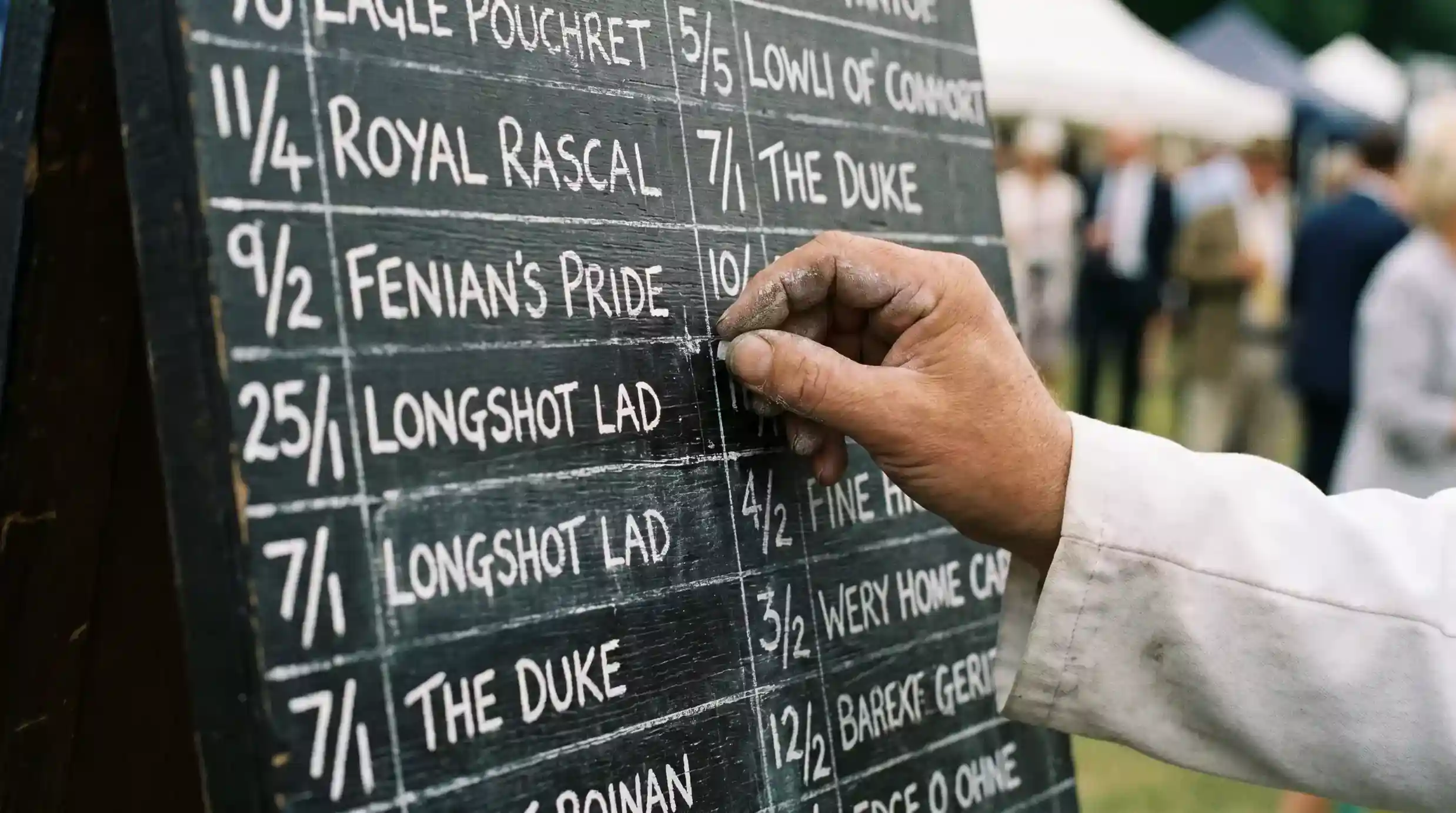
The Number Behind the Number
A friend once asked me what odds of 7/2 actually mean. I told him it means the bookmaker believes — roughly — that the horse has about a 22% chance of winning. He stared at me for a moment and then said, “So when I back a 7/2 shot, I am disagreeing with a 22% estimate?” Exactly. Every betting decision is a disagreement with a probability. And if you cannot quantify what you are disagreeing with, you are gambling blind.
Implied probability is the probability embedded in a set of odds. For win odds, the conversion is simple: divide 1 by the decimal odds. For place odds, the same conversion applies, but the resulting probability tells you something different — it tells you what the bookmaker’s price implies about the horse’s chance of finishing in the places. Comparing that number against your own assessment is the foundation of profitable place betting.
Converting Place Odds to Implied Probability
The formula works the same regardless of whether you start with fractional or decimal odds. Fractional first: place odds of 5/2 mean a potential profit of five units for every two staked, returning seven total. In decimal, that is 3.5. The implied probability is 1 / 3.5 = 0.286, or 28.6%.
Place odds of 2/1 in decimal are 3.0. Implied probability: 1 / 3.0 = 33.3%. Place odds of evens (1/1) in decimal are 2.0. Implied probability: 50%. The shorter the place odds, the higher the implied probability, which makes intuitive sense — the bookmaker is offering less profit per unit staked because they believe the outcome is more likely.
Where place odds come from is important. In standard UK each-way betting, the place odds are derived by dividing the win odds by the place fraction. At 1/4 place terms, a horse priced at 12/1 to win has place odds of 12/4 = 3/1 (decimal 4.0), giving an implied place probability of 25%. At 1/5 terms on the same win price, the place odds are 12/5 = 2.4/1 (decimal 3.4), giving an implied probability of 29.4%. The fraction matters because it changes the implied probability by several percentage points — enough to flip a bet from marginal to valuable or from valuable to negative.
Top online casinos in the UK
- WinBeastBonus: €5000 + 500 FS + €650 Freebet · Payout speed: 1-3 business days
- NightWinBonus: £900 + 400 free spins · Payout speed: 1-3 business days
- ZombillionBonus: Welcome Pack 250% up to £4000 + 200 FS · Payout speed: 1-3 business days
- AmunbetBonus: Join now and get 450% up to 2,700 GBP + 450 FS · Payout speed: 1-3 business days
- JetsetspinsBonus: 200% Bonus + 100 Free Spins + Free Royal Wheel · Payout speed: 1-3 business days
- BritsinoBonus: Welcome Package – Get your £2,200 + 2,000 FS · Payout speed: 1-3 business days
Why Implied Place Probability Does Not Equal True Place Probability
If bookmaker prices perfectly reflected reality, every horse would place at exactly the rate its price implies, and no bettor could ever profit long-term. Prices do not perfectly reflect reality. They reflect reality plus a margin, plus market distortion from weight of money, plus the inherent difficulty of modelling place probability from win probability.
The overround inflates implied probabilities across the board. In a twelve-runner race paying three places, the sum of all implied place probabilities might total 340% rather than the fair 300%. That extra 40 percentage points is margin. It means every horse’s implied place probability is overstated by roughly 11-12% of its fair value. A horse with a true 30% place chance might be priced as if it has a 33% chance — and the 33% is what the odds show you.
Favourites win around 30-35% of the time per Matchbook Insights analysis, and their place probability is well-studied and accurately priced. But the relationship between win probability and place probability is non-linear for longer-priced horses. A 20/1 shot has roughly a 5% win chance, but its place chance in a large field might be 22-25% — far higher than the simple ratio would suggest. Models that estimate place probability by scaling win probability with a fixed multiplier systematically misprice these runners. That mispricing is where each-way value on longshots originates.
Building Your Own Place Probability Estimates
Implied probability tells you what the market thinks. Your edge depends on what you think — and on being right more often than not. Building a place probability estimate for a horse is less precise than building a win probability estimate, but several factors help.
Start with the horse’s recent finishing positions. A horse that has finished in the top four in six of its last eight starts at the class level has a demonstrable place record that informs a baseline probability. Adjust for field size: a horse that regularly places in twelve-runner fields may find it harder to place in a twenty-runner handicap. Adjust for ground, distance, and the place terms specific to the race.
Running style matters for place probability more than for win probability. A horse that consistently finishes strongly but lacks the gear change to win is the archetypal place horse. Its place probability is high relative to its win probability because it grinds into the frame without threatening the winner. The market prices its win chance fairly but underestimates the frequency with which it will fill a place slot.
Track the results. After fifty bets where you have recorded your estimated place probability and the implied probability from the odds, you can measure calibration. If you are estimating 30% place chances and horses are placing 35% of the time, your estimates are conservative and you can bet more aggressively. If they are placing 24% of the time, your estimates are too generous and you need to tighten your criteria.
Practical Application in Each-Way Betting
Every each-way bet is two bets, and the place portion is the one that lands more often. Understanding its implied probability lets you evaluate it separately. Suppose a horse is 14/1 to win at 1/4 place terms. The place odds are 14/4 = 3.5/1, giving an implied place probability of 22.2%. You estimate the horse’s true place probability at 30%. The difference — 7.8 percentage points — is your estimated edge on the place portion alone.
On the win side, the implied probability at 14/1 is 6.7%. You estimate the win chance at 7%. That is a 0.3 percentage point edge — barely worth betting on its own. But the combined expected value of both portions, weighted by their respective edges, is positive because the place portion carries a substantial edge. The each-way bet is profitable primarily because of the place component, not the win component.
The UK Gambling Commission reported remote horse racing GGY of 766.7 million pounds in the year to March 2025. A material share of that yield flows from punters who bet each-way without ever comparing implied place probability to their own estimate. They are, in effect, paying the overround without checking whether the ticket price is fair. The act of converting place odds to implied probability takes ten seconds and transforms each-way betting from a casual punt into an informed decision.
A Habit Worth Developing
Implied probability is not a magic formula. It will not tell you which horse to back. What it will do is tell you whether the price on offer compensates fairly for the risk. Once that calculation becomes second nature — glance at the place odds, divide one by the decimal price, compare against your estimate — you will find yourself naturally avoiding bad value and gravitating toward good value. Over hundreds of bets, that gravitational pull is the difference between a bettor who gives money to the market and one who takes it away.
How do I convert fractional place odds to implied probability?
Divide the denominator by the sum of numerator and denominator. For place odds of 3/1, the calculation is 1 / (3 + 1) = 0.25, or 25%. Alternatively, convert to decimal first (3/1 = 4.0) and divide 1 by the decimal: 1 / 4.0 = 25%.
Does the overround affect implied place probability?
Yes. The overround inflates implied probabilities for every runner, meaning the market overstates each horse’s place chance slightly. The sum of all implied place probabilities in a three-place market will exceed 300%. To get a truer picture, divide each horse’s implied probability by the total and multiply by 300%, which removes the overround proportionally.
Should I calculate implied probability for every bet?
Ideally, yes. At minimum, convert the place odds whenever you are considering an each-way bet or a place-only bet. The calculation takes seconds and provides a clear benchmark against which to measure your own estimate of the horse’s place chance. Over time, this habit sharpens your sense of value and reduces the number of negative-expectation bets in your portfolio.
The full picture is in our guide to UK place and each-way betting.
The margin inside those odds: the overround.
Created by the ”Horse Racing Show bet” editorial team.