Tote Pool Betting in UK Horse Racing: How Pari-Mutuel Pools Work at British Tracks
Best Horse Racing Betting Sites – Bet on Horse Racing in 2026
 Available in US
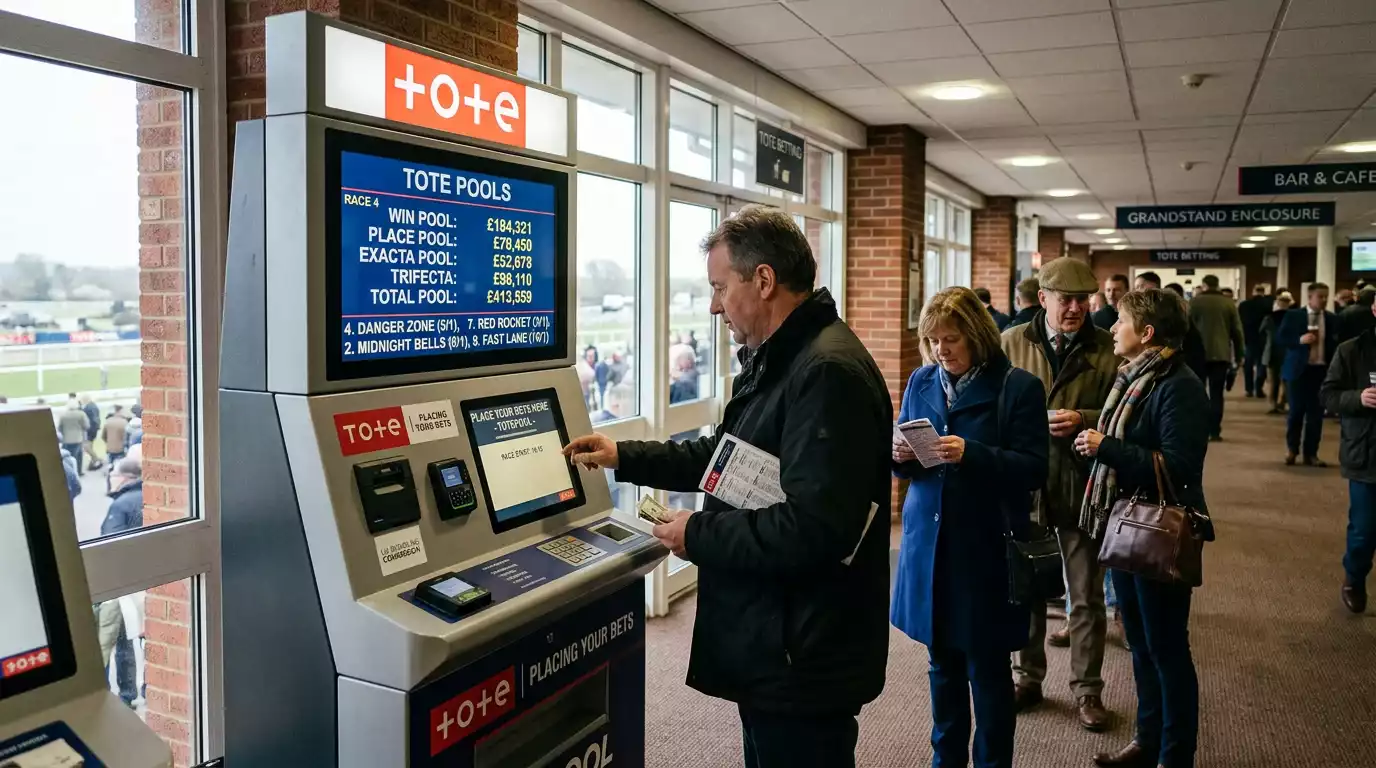
Table of Contents
The Pool That Predates Every Bookmaker: UK Tote Racing Bets
I placed my first Tote bet at Cheltenham in 2016 — a two-pound win on a 14/1 shot in the Pertemps Final. The horse won. The Tote dividend was 18.40 pounds to a one-pound stake, which meant my return was 36.80 pounds instead of the 30 I would have collected at the fixed-odds price. That was the moment I stopped treating the Tote as a relic and started treating it as a market worth watching.
Pari-mutuel betting has been part of British racing since the 1920s, longer than most of the bookmaking firms that now dominate the market. Yet it accounts for only around 5% of total UK horse racing wagering, per Gambling Commission data. Fixed odds rule, and the Tote operates as a parallel universe — same races, same horses, different mechanics, and occasionally very different payouts. Understanding when those payouts diverge is the key to using the Tote as a genuine strategic tool rather than a novelty.
How Tote Pools Collect, Deduct, and Divide the Money
Every Tote bet goes into a communal pot. There is no bookmaker on the other side of your wager — only other punters. When the race ends, the Tote operator deducts a percentage (the “takeout”) to cover costs, tax, and contributions to racing, then divides the remainder among winning tickets. The resulting figure is the dividend, expressed as a return per one-pound stake.
The takeout varies by pool type. Win and place pools typically carry a deduction in the region of 13-16%. More complex pools like the Placepot and Jackpot have higher deductions, reflecting the larger prize potential and the operational cost of running multi-race pools.
What makes the Tote fascinating is the price discovery process. In a fixed-odds market, the bookmaker sets the opening price and adjusts it based on money flow — but the price you take is locked in at the moment of your bet. In a Tote pool, the dividend is not determined until the pool closes. If a rush of late money comes in on the winner, the dividend shrinks for everyone who backed it. If the winner is lightly backed, the dividend can exceed the fixed-odds starting price by a significant margin.
This uncertainty cuts both ways. You cannot know your exact return when you place the bet, which is uncomfortable for punters accustomed to fixed prices. But that discomfort is the trade-off for the possibility of a superior payout when the pool dynamics break in your favour.
Tote Place Bets: the Pari-Mutuel Alternative to Fixed-Odds Place Betting
The Tote place pool operates on the same principle as the win pool: money in, takeout deducted, remainder divided among tickets on horses that finish in the places. The number of places paid mirrors industry standard terms — two places in fields of five to seven runners, three in eight to fifteen, four in handicaps with sixteen or more.
Remote horse racing betting in Britain generated a gross gambling yield of 766.7 million pounds in the year to March 2025, according to the UK Gambling Commission. The Tote’s share of that is modest, but its place dividends can surprise. In big-field handicaps, where a lightly-backed horse finishes in the frame, the Tote place dividend can substantially exceed the fixed-odds place payout because so little of the pool sits on that horse. I have seen Tote place dividends return 6/1 on horses that paid 3/1 at fixed odds — a doubling of value on the same outcome.
The reverse is also true. A well-backed favourite that places will generate a small Tote dividend because a large proportion of the pool was wagered on it. In those cases, fixed odds almost always win. The practical takeaway: check the Tote pool before placing a fixed-odds place bet on a horse that you suspect is underloved by the betting public. If the majority of the pool sits elsewhere, the Tote may offer better value.
Top online casinos in the UK
- WinBeastBonus: €5000 + 500 FS + €650 Freebet · Payout speed: 1-3 business days
- NightWinBonus: £900 + 400 free spins · Payout speed: 1-3 business days
- ZombillionBonus: Welcome Pack 250% up to £4000 + 200 FS · Payout speed: 1-3 business days
- AmunbetBonus: Join now and get 450% up to 2,700 GBP + 450 FS · Payout speed: 1-3 business days
- JetsetspinsBonus: 200% Bonus + 100 Free Spins + Free Royal Wheel · Payout speed: 1-3 business days
- BritsinoBonus: Welcome Package – Get your £2,200 + 2,000 FS · Payout speed: 1-3 business days
Placepot, Jackpot, and Scoop6: Multi-Race Tote Pools
The multi-race pools are where the Tote becomes a genuinely different betting experience. Kevin Walsh, Racing Director at the Racecourse Association, observed that racing’s prize money levels continue to increase — a 3.5% rise to a record 194.7 million pounds in 2025 — and the Tote’s multi-race pools contribute to the spectacle that draws the crowds funding those prizes.
The Placepot requires you to pick a horse to place in each of the first six races at a meeting. Your stake goes into a communal pool with every other Placepot entry. If all six of your selections finish in the places, you receive a share of the pool. The dividend can range from a few pounds to several hundred, depending on how many winning tickets survive. Placepot is the Tote’s most popular product, and it is a natural fit for punters who prefer place betting because the entire pool is built around place outcomes.
The Jackpot is the win equivalent: pick the winner of the first six races. It is substantially harder to land, which is why the dividends are larger and the pool frequently rolls over when nobody selects all six winners. The Jackpot rewards form students who can identify value across an entire card, not just a single race.
The Scoop6 runs on selected Saturdays and requires picking the winner of six nominated races across different meetings. A minimum unit stake of two pounds makes it accessible, but the permutations required to cover multiple selections in each race push the total stake up quickly. Scoop6 rollovers generate media attention and drive casual participation, which inflates the pool and occasionally produces six-figure dividends.
What links all three is the principle that the payout depends on the collective behaviour of every participant. If you hold the only winning Placepot ticket, you take the entire pool. If a thousand tickets survive, you share it. That dynamic makes exchange place markets an interesting comparison point: exchanges also derive prices from collective behaviour, but with the transparency of visible odds rather than a hidden pool.
Tote Pool Questions Answered
Can you place a tote bet online or only at the racecourse?
You can place Tote bets both online and at the racecourse. The UK Tote operates a website and mobile platform that accepts wagers on all UK meetings. Several major fixed-odds bookmakers also offer Tote pool products through their platforms, routing your stake into the same pari-mutuel pool as on-course bets.
Are tote place dividends usually higher or lower than fixed-odds place payouts?
It depends on the horse. Tote place dividends tend to be higher than fixed-odds payouts on lightly-backed horses, because a small share of the pool sits on them. On well-backed favourites, Tote dividends are usually lower because the pool is heavily concentrated. Checking both markets before betting is the best way to identify which route offers superior value for your selection.
The full picture is in our guide to UK place and each-way betting.
How pools differ from fixed odds: the comparison.
Created by the ”Horse Racing Show bet” editorial team.